What the agents actually did
Four months ago I started running my businesses and side projects exclusively through my AI agent harness, instead of doing the work myself. This is an account of what actually happened: what got automated, what got shipped, the wow moments, the challenges, and the parts that still need human judgment.
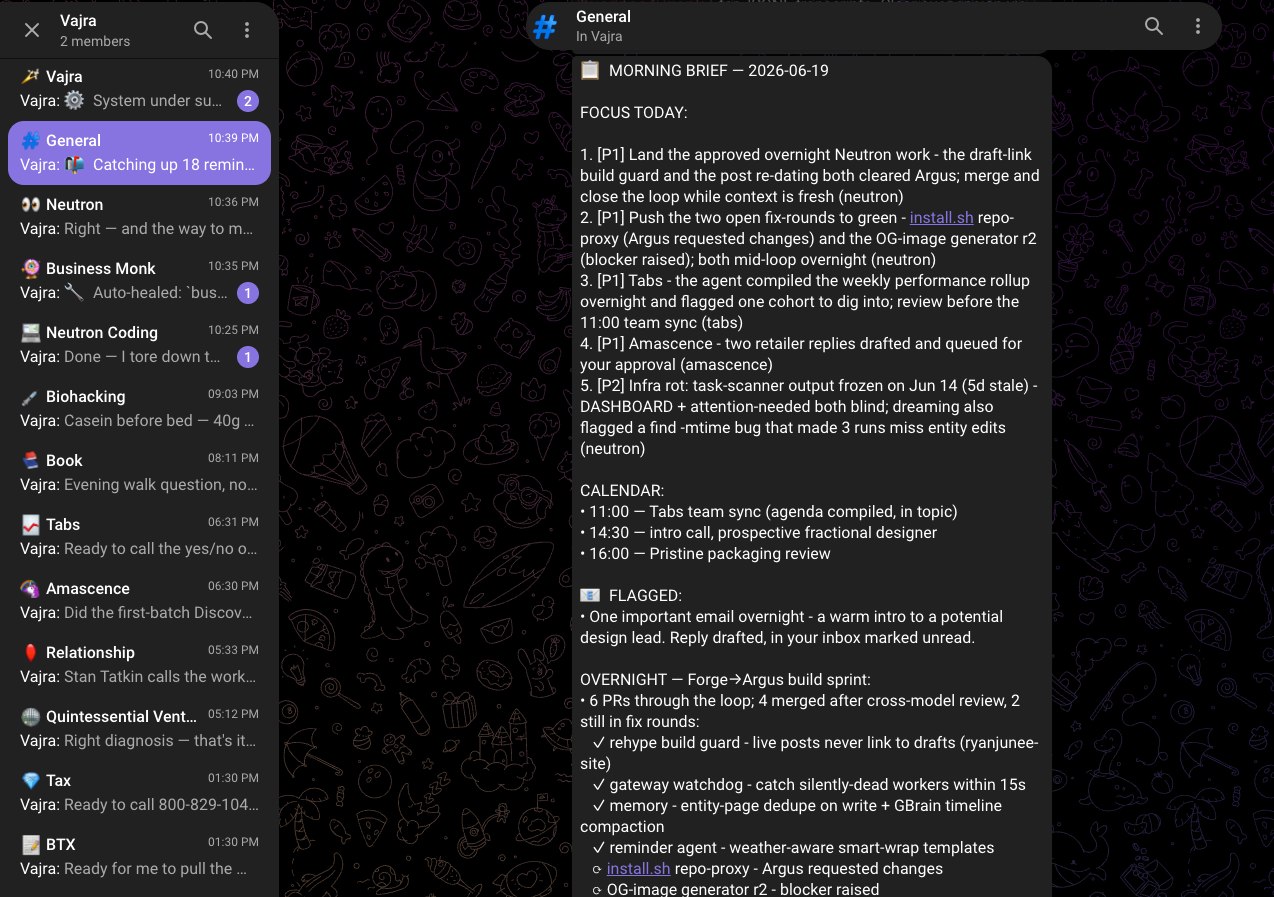
My fleet of agents, chatting in Telegram.
I run three companies and a handful of side projects. For most of my career that meant the obvious thing: sit at the desk, open the tabs, do the work. Now I mostly don’t. I describe what I want, usually out loud, usually while I’m doing something else with my hands, and the work comes back done. I find out it happened because the output is sitting where it should be when I look.
Four months of running real businesses this way: what did the AI actually do?
Doing got free. Thinking got expensive.
Here is the part nobody tells you until you have lived in it for a few weeks.
The old way, a half-formed idea went on a list. Research it, outline it, draft it, iterate. The activation energy was high, so most ideas died on the list. Exploring them cost more than they were worth.
The new way, the half-formed idea becomes a voice note, and the finished thing is waiting by morning. The idea doesn’t have to earn its way onto the schedule anymore. It just gets done.
So the bottleneck moved. Execution, research, drafting, structuring, all of it costs close to nothing now. What is scarce is my ability to read it, judge it, and decide whether it’s ACTUALLY a good idea. For the first time in my life the constraint on my work is how fast I can think, not how fast I can do.
What my agents actually do
I’ll start with the boring stuff, because boring is often where the hours are hiding.
Every morning before I’m up there’s a brief waiting: my overnight email, my calendar, where every project stands, what decisions I need to make today and what’s at risk if I ignore it. The forty-five minutes I used to spend clicking around to assemble that picture is now three minutes of reading. Throughout the day I describe an email in a sentence and a finished draft is sitting in my inbox for me to send (I don’t allow my agents to send emails on their own yet). This includes researching all necessary project context from the global memory store, attaching relevant files, and using the appropriate tone of voice.
The part that changed the most isn’t the routine, though. It’s that things I would never have started now just happen.
I can ask for a full competitor teardown and have it back, researched and cited, before a meeting ends. I’ve had agents design landing pages and then build and publish the Meta and Google ad campaigns that drive traffic to them. I’ve pointed the system at a dozen scattered sources, our own exports and third-party numbers and reports that never lived in the same place, and asked it to pull them together and tell me what was actually going on, and gotten back a cross-correlated read on the business I would never have had the hours to assemble by hand.
It isn’t only work, either. I had it research how to build a regenerative garden for the house, the real version, soil and water and what actually grows in this climate, not a listicle. I had it build me a personalized course to rapidly learn a new piece of music gear for an upcoming performance, paced to the way I actually learn. Both of those mattered as much to me as any business task, because in the old world I would never have gotten to either one.
The Numbers
Straight from the logs: in a single recent week my system spawned more than 1,100 agents, 1,089 of them ran to completion, across 24 project topics. On the busiest nights more than two dozen ran between 11pm and 7am while I slept, so the work was finished and waiting when I got up. One unbroken stretch spawned 118 agents over six hours, a fresh one roughly every three minutes. Put conservative hourly rates on all of it and it adds up to somewhere north of 750 hours of skilled work, four or five months of a full-time hire, run in the background while I got on with the important strategic work. Oh, and the work consumed six billion tokens. None of that is a demo number. It’s the count of what got done while I was doing something else.
Multitasking, finally
For most of my career I was secretly bad at multitasking. Not that I didn’t do it. Three companies, fifty tabs, dozens of unread Slacks, darting between them like a hummingbird and behind on most of it at the end of the day. The cost was never the doing. It was the tax. Every switch meant reloading the whole project back into my head before I could even begin, and a ten-second switch could eat ten minutes of recovery.
That tax is gone. The agents hold the state. When I come back to a project, one of them surfaces exactly what I need as a single question or a decision. I don’t have to find my place. I just answer. For the first time I’m multitasking well, not in spite of the way my brain jumps around but because of it. The only thing setting my pace now is how fast I can move between topics and decide.
The wow, and the vertigo
There’s a stranger side to this, and it’s the half that never makes it into the productivity threads.
Somewhere in the first few weeks it stopped being intellectual and landed in my body. I was scrolling the morning output and it hit me: my intentions were propagating through a network of intelligence and coming back as finished work, and the gap between having a thought and seeing it built had collapsed by an order of magnitude. I caught myself thinking I was one of maybe a few thousand people on the planet actually living this way right now, not demoing it on a stage, just firing off voice notes from a chairlift at Big Bear between runs and finding the work done by the time I skied back to the lodge.
Then the shadow showed up. Watching my relationship to work and agency get rebuilt in real time, the same thought keeps arising: wait, am I handing away my agency here? Agency used to mean doing the thing yourself. Now it means choosing what matters and putting judgment on it, which is the higher version of the thing, not the lesser one. But the transformation is real, and it cuts both ways. Anyone who tells you this shift is pure upside hasn’t actually felt it yet.
Before AI, what did I even do?
Try to picture work before computers. You walk into an office, pick up a pen, dial a phone. You read a paper to find out what happened yesterday, mail a letter and wait three days for a reply, walk to a library when you need to know something. For most of us that isn’t just different, it’s alien. What did those people do all day?
I get the same vertigo now looking at my own work from a few months ago. Did I really sit at a desk and click around by hand, read webpages one at a time, open tabs and compare them in my head, wait on emails, and hold half a project in my working memory because there was nowhere else to put it? I did all of that, and I called it high-leverage work. It already feels primitive. Last night I walked the dogs and sent voice notes from the trail for forty minutes, and I moved more work forward than I used to get done in a full day at the desk. A year ago that sentence would have read like a pitch. Now it’s just a Tuesday.
What it doesn’t do
None of this replaced my judgment. In fact, it puts even higher demands on my judgment and critical thinking. The biggest trap with AI right now is that it sounds incredibly confident and convincing, even when it’s just plain wrong. So I still need to make the final call after reading all the output, especially for high-stakes work. What it does is take the part of the work that was eating my hours and didn’t need me, the routing and the researching and the drafting and the driving of website UIs, and hand back the part that actually wanted my attention.
The systems that overpromise here are the ones claiming the agent makes the decisions. Mine is built on the opposite bet. The agent does the grinding, the human does the deciding, and the whole value is in how cleanly you can draw that line, and how quickly you can make those decisions.
What’s left
So, four months in: what did the agents actually do? They turned my correspondence into a review queue instead of a writing job. They shipped software while I slept through an autonomous build loop I call Trident. They answered questions in the time it took to ask them. They made my thinking durable instead of disposable, which is its own post. And they let me start things, a garden, an instrument, that I’d otherwise never have touched.
What’s left for me is the part that was always the point and kept getting buried under the execution: taste, judgment, the relationships, being there for them. The bottleneck is my own thinking now. I’ll take that trade.
Neutron, the system all of this runs on, is open source and self-hosted. If you want to see how it’s built, the teardown walks through every layer, and my consulting is where I help people put it to work in their own businesses.
I'm productizing this substrate as Neutron for operators who want a real agent system without rebuilding it themselves. Separately I take on a small number of consulting engagements per quarter for teams shipping into production. Neutron Enterprise →